

Taxation of Gifts in the hands of Non-Resident Indian (NRI)
Any receipt of money, movable property, or immovable property received as a gift is taxable when it is received:
Without consideration, or
For inadequate consideration
Such receipts are taxable under the head “Income from Other Sources” in the hands of the recipient.
Non-Resident Individuals (NRIs) must assess whether a transaction received in India qualifies as a gift received without or for inadequate consideration, as it may attract tax.
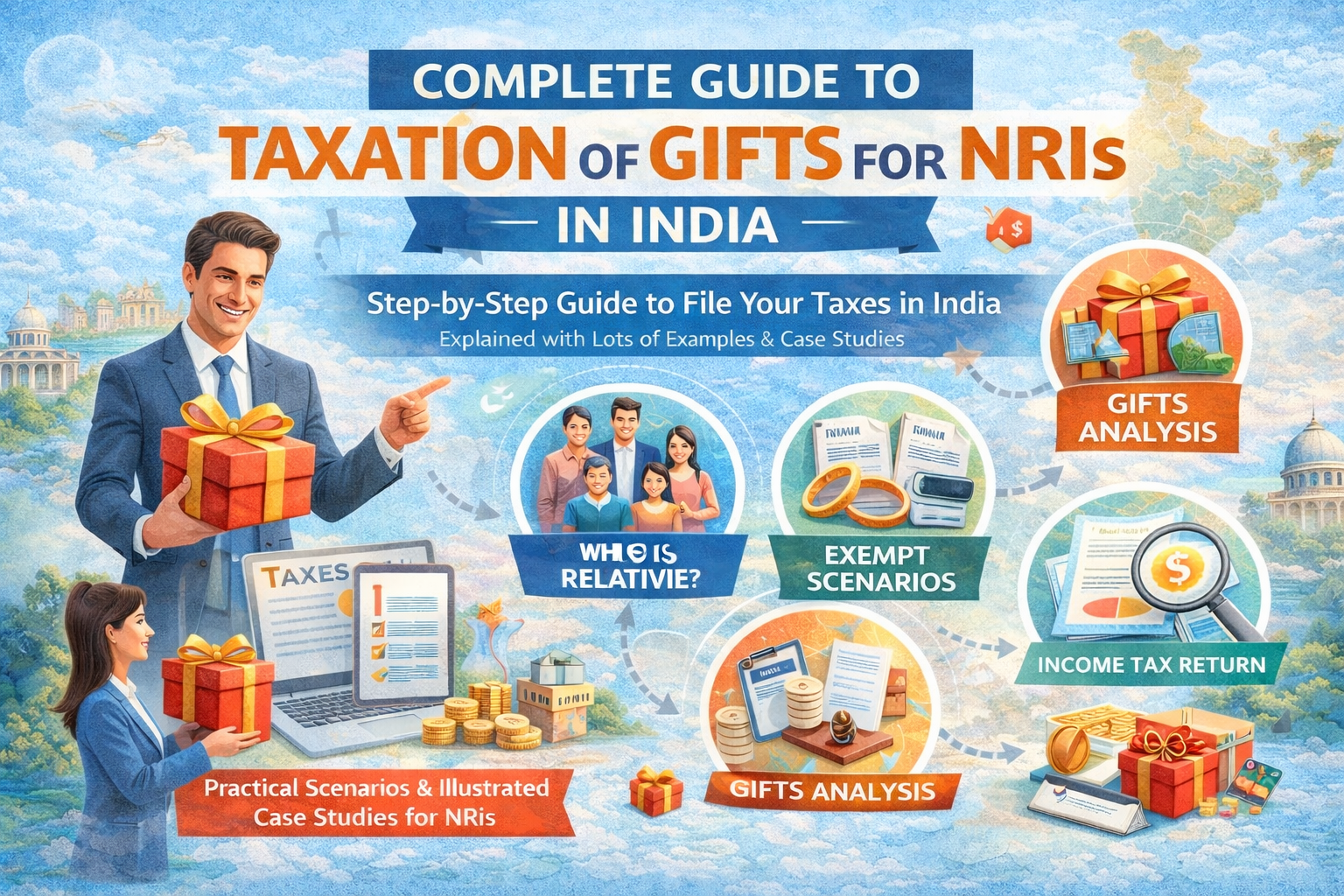
Taxation of Gifts Received
Gifts received by a person are taxable in the hands of the recipient.
The tax treatment depends on the nature of the asset received.
Gifts received from a person are chargeable to tax in the hands of recipient and the provisions relating to taxation of said gifts are tabulated below:
| Kind of gift covered | Monetary threshold | Quantum taxable |
| a. Any sum of money without consideration | Sum > Rs 50,000# | Entire sum of money received |
| b. Any immovable property without consideration | Stamp Duty Value* > Rs 50,000 | Stamp duty value of the property |
| c. Any immovable property for inadequate consideration | Difference between Stamp duty value and consideration, is higher of following amounts:
| Stamp duty value Minus Consideration |
| d. Any movable property (Refer Note 1) without consideration | Fair market value (FMV)*** – (Refer Note 2) > Rs 50,000 | FMV of such property |
| e. Any movable property# for an inadequate consideration | FMV exceeds consideration by > Rs 50,000 | FMV Minus Consideration |
#Refers to Aggregate value of gifts received during the year
Movable property includes the following assets:
Shares and securities
Jewellery
Bullion
Archaeological collections
Drawings
Paintings
Sculptures
Any work of art
Note 2: Determination of Fair Market Value (FMV)
The method for determining FMV depends on the type of asset.
a. Shares and Securities
Quoted shares: FMV is the price recorded on the recognised stock exchange
Unquoted shares: FMV is calculated as per prescribed valuation rules
b. Other Movable Assets
For jewellery, bullion, archaeological collections, drawings, paintings, sculptures, and works of art, FMV is the price the asset would fetch in the open market.
CA Mitesh and Associates is India's leading CA Firm Firm with special focus on accurate NRI Income Tax Return Filing and NRI Handling Income Tax Notices in India. Contact us via WhatsApp: Click Here or Email: info@mnpartners.in
Exceptions Where Gifts Are Not Taxable
Receipt of money or property is not taxable, even if it exceeds ₹50,000, when received under the following circumstances:
From a relative*
On the occasion of the marriage of the individual
Under a will or by inheritance
In contemplation of the death of the donor
From any local authority
From an individual to a trust created solely for the benefit of the individual’s relative
From any fund, foundation, university, educational institution, hospital, or medical institution
From or by any trust or institution
From persons or classes of persons notified under prescribed conditions (Finance Act, 2019)
By an individual for medical treatment of self or family for COVID-19, subject to prescribed conditions (Finance Act, 2022)
By family members of a deceased person from the employer (no limit), or from others up to ₹10 lakh, where death was due to COVID-19 and payment is received within 12 months (Finance Act, 2022)
Definition of Relative
For an individual, relative means:
Spouse
Brother or sister of the individual or spouse
Brother or sister of either parent
Lineal ascendant or descendant of the individual or spouse
Spouse of the relatives listed above
For a HUF, relative means any member of the HUF.
Definition of Family
Family includes:
Spouse
Children
Parents, brother, or sister who are wholly or mainly dependent on the individual
Income Deemed to Accrue or Arise in India
A gift of money made on or after 5 July 2019 by a resident in India to a Non-Resident in the NR’s overseas bank account is taxable in India if:
The amount exceeds ₹50,000, and
The gift does not fall under the exceptions listed above
A similar rule applies from 1 April 2023 for gifts made by a resident in India to a Resident but Not Ordinarily Resident (RNOR) in the RNOR’s overseas bank account.
Tax Rate on Gifts
Taxable gifts are taxed under “Income from Other Sources”.
The tax rate depends on the total income of the NRI and the applicable slab rate.
The person giving the gift must deduct Tax Deducted at Source (TDS) at the maximum rate of 30% on the gift amount paid to the NRI.
CA Mitesh and Associates is India's leading CA Firm Firm with special focus on accurate NRI Income Tax Return Filing and NRI Handling Income Tax Notices in India. Contact us via WhatsApp: Click Here or Email: info@mnpartners.in
Key Points to Note for NRIs and RNORs
The following transactions may attract tax under the Act:
a. Credit exceeding ₹50,000 received by an NRI in an NRO or NRE account from friends or relatives, where the amount is not repayable and does not fall under the exceptions.
b. Credit exceeding ₹50,000 received by an NRI or RNOR in an overseas bank account from a person resident in India, where the amount is not repayable and does not fall under the exceptions.
c. Purchase of immovable property or unlisted shares or securities by an NRI at a value that does not match the prescribed valuation rules.

FAQs
Answer:
i. Shares and Securities
Listed (quoted) shares:
FMV is the price quoted on the recognised stock exchange.Unlisted shares:
FMV is calculated using the valuation method prescribed under the Income-tax Rules.
ii. Other Capital Assets
For assets such as jewellery, bullion, archaeological collections, drawings, paintings, sculptures, and works of art, FMV is the price the asset would fetch in the open market.
Question 5. Which stamp duty value should be considered for immovable property?
Answer: The stamp duty value applicable on the date of registration of the immovable property must be considered.
If the date of agreement and the date of registration are different, the stamp duty value as on the date of agreement can be considered, provided the following condition is met:
At least part of the sale consideration is paid on or before the date of agreement using any of the following modes:
Account payee cheque
Account payee bank draft
Electronic clearing system through a bank account
Any other prescribed electronic mode
Question 6. Case Study: Different Agreement and Registration Dates
Facts:
Date of agreement: 5 January 2003
Date of registration: 29 July 2023
Total sale consideration: ₹2 crore
Amount paid before agreement: ₹50 lakh
Mode of payment: Account payee cheque
Answer: Since the agreement date and registration date differ, and part of the consideration was paid before the agreement date using an approved payment mode, the stamp duty value as on 5 January 2003 must be considered.
Question 7. What if part of the payment is made in cash?
Answer: Yes, the result changes.
If any part of the payment is made in cash, the condition for using the agreement date is not met.
In such cases, the stamp duty value as on the registration date, that is 29 July 2023, must be considered.
CA Mitesh and Associates is India's leading CA Firm Firm with special focus on accurate NRI Income Tax Return Filing and NRI Handling Income Tax Notices in India. Contact us via WhatsApp: Click Here or Email: info@mnpartners.in
Question 8. Are there exceptions where taxable gifts are not taxed?
Answer: A gift received by a person is not taxable if it is received under any of the following situations:
From a relative (refer FAQ 9)
On the marriage of the individual
Under a will or by inheritance
In contemplation of the death of the donor
From a local authority
From an individual through a trust created only for the benefit of the individual’s relative
From any fund, foundation, university, educational institution, hospital, or medical institution
From or by any specified trust or institution
From notified persons or classes of persons under prescribed conditions (Finance Act, 2019)
For COVID-19 medical treatment expenses of self or family, subject to prescribed conditions (Finance Act, 2022)
By family members of a deceased person from the employer (no limit), or from others up to ₹10 lakh, where death was due to COVID-19 and payment is received within 12 months (Finance Act, 2022)
Question 9. Who is treated as a “relative” under the Act?
Answer: In case of an Individual
A relative includes:
Spouse
Brother or sister of the individual
Brother or sister of the spouse
Brother or sister of either parent
Lineal ascendant or descendant of the individual
Lineal ascendant or descendant of the spouse
Spouse of the persons listed above
In case of a HUF - Any member of the HUF is treated as a relative.
Question 10. Who is considered a “family” under the Act?
Answer: Family includes:
Spouse
Children
Parents, brother, or sister who are wholly or mainly dependent on the individual
Question 11. At what rate are taxable gifts taxed in India?
Answer: Taxable gifts are taxed under “Income from Other Sources”.
They are taxed at the applicable slab rate of the recipient.
The highest rate can go up to 30%, plus applicable surcharge and 4% cess.
Question 12. Are gifts from Indian residents to NR/RNOR taxable in India?
Answer: A gift of money made on or after 5 July 2019 by a resident in India to a Non-Resident in the NR’s overseas bank account is taxable in India if:
The amount exceeds ₹50,000, and
The gift does not fall under the specified exemptions
A similar rule applies from 1 April 2023 for gifts made to a RNOR.
In such cases, the donor must deduct TDS at 30% on the gift amount.
Question 13. Gift from Grandfather to NR on Birthday
An NR receives ₹5,00,000 from his grandfather on his 18th birthday. Is it taxable?
Answer: No. A grandfather is a lineal ascendant and qualifies as a relative. The gift is not taxable.
CA Mitesh and Associates is India's leading CA Firm Firm with special focus on accurate NRI Income Tax Return Filing and NRI Handling Income Tax Notices in India. Contact us via WhatsApp: Click Here or Email: info@mnpartners.in
Question 14. Gift Received in Contemplation of Death
An NR receives ₹1,00,000 from a neighbour on the neighbour’s deathbed. Is it taxable?
Answer: No. Gifts received in contemplation of death are not taxable.
Question 15. Gift from a Friend
An NR receives ₹5,00,000 from a resident friend on his birthday. Is it taxable?
Answer: Yes. The gift is taxable in the hands of the NR.
The friend must deduct TDS at 30% on the gift amount.
Question 16. Purchase of Immovable Property Below Stamp Duty Value
Facts:
Date of agreement and registration: 25 June 2023
Purchase consideration: ₹24,20,000
Stamp duty value: ₹27,00,000
Answer: When a person buys immovable property for a value lower than the stamp duty value, the difference may be taxed.
If the difference between stamp duty value and consideration exceeds both:
₹50,000, and
10% of the consideration
then the excess amount is taxed as Income from Other Sources.
In this case:
Difference: ₹2,80,000
10% of consideration: ₹2,42,000
Since both conditions are met, ₹2,80,000 is taxable in the hands of the NR.
The NR may challenge the stamp duty value by submitting supporting evidence. Acceptance depends on the Assessing Officer.
Question 17. Revised Consideration Scenario
What if the purchase consideration is ₹26,00,000?
Answer: Difference: ₹1,00,000
10% of consideration: ₹2,60,000
Although the difference exceeds ₹50,000, it does not exceed 10% of consideration.
As both conditions are not met, the difference of ₹1,00,000 is not taxable.
CA Mitesh and Associates is India's leading CA Firm Firm with special focus on accurate NRI Income Tax Return Filing and NRI Handling Income Tax Notices in India. Contact us via WhatsApp: Click Here or Email: info@mnpartners.in
DISCLAIMER

CMS Meta
Comments