

FAST-DS 2026
FAST-DS 2026: Complete Guide to the Foreign Assets of Small Taxpayers Disclosure Scheme
- FAST-DS 2026: What Indian Taxpayers Need to Know
- What Is FAST-DS 2026?
- Who Can Use FAST-DS 2026?
- ₹1 Crore vs ₹5 Crore FAST-DS Limit
- What Foreign Assets Can Be Covered?
- FAST-DS 2026 Valuation Date
- How to File FAST-DS 2026
- What Immunity Does FAST-DS 2026 Provide?
- What FAST-DS 2026 Does Not Mean
- Common FAST-DS 2026 Situations
- FAST-DS 2026 and Schedule FA
- Documents Required for FAST-DS 2026
- Five Important Mistakes to Avoid
- Is FAST-DS 2026 Applicable to NRIs?
- FAST-DS 2026: Practical Checklist
- Should You File FAST-DS 2026?
- Conclusion
- Frequently Asked Questions About FAST-DS 2026
FAST-DS 2026: What Indian Taxpayers Need to Know
The Foreign Assets of Small Taxpayers Disclosure Scheme, 2026 (FAST-DS 2026) is a one-time compliance opportunity introduced by the Government of India for eligible taxpayers who have not properly disclosed certain foreign assets or foreign income in their Indian income tax returns.
The scheme is particularly relevant for individuals who have lived or worked overseas, returned to India after a period of non-residence, received foreign shares or ESOPs, maintained overseas bank or investment accounts, or inherited foreign assets. It can also apply where the underlying income was already taxed in India but the foreign asset itself was inadvertently omitted from the relevant foreign asset disclosure schedule.
FAST-DS 2026 was introduced through Chapter IV of the Finance Act, 2026. The Central Government subsequently notified the Foreign Assets of Small Taxpayers – Disclosure Scheme Rules, 2026, which came into force on 16 August 2026. The declaration window is open until 31 December 2026.
The importance of FAST-DS lies in the distinction it makes between two very different situations:
Genuine undisclosed foreign assets or foreign income, where the source has not been properly disclosed or explained; and
A disclosure or reporting lapse, where the foreign asset was acquired from income that was already taxed or while the taxpayer was non-resident, but the asset was subsequently omitted from the required disclosure.
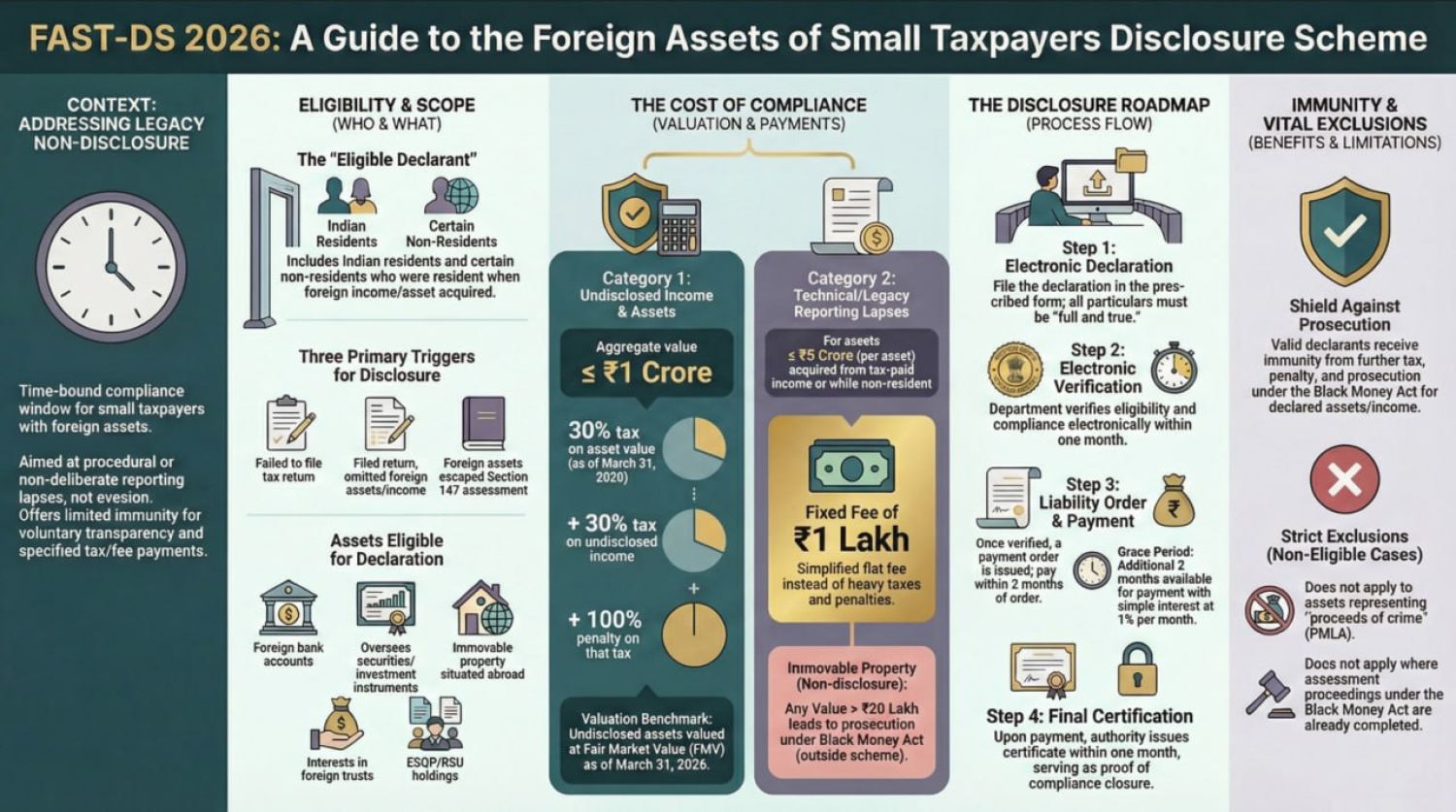
The financial consequences are dramatically different. Under the first category, the effective amount payable can be 60% of the relevant value, subject to the ₹1 crore threshold. Under the second category, eligible taxpayers can regularise qualifying assets up to ₹5 crore by paying a flat ₹1 lakh fee.
This article explains FAST-DS 2026 eligibility, the ₹1 crore and ₹5 crore limits, tax and fee calculations, valuation rules, filing procedure, Forms 1 to 4, payment timelines, immunity and important precautions.

What Is FAST-DS 2026?
FAST-DS stands for Foreign Assets of Small Taxpayers – Disclosure Scheme, 2026.
It is a special, time-bound disclosure mechanism introduced under the Finance Act, 2026 to allow eligible taxpayers to regularise specified historical non-disclosures involving foreign assets and foreign-source income.
The scheme is designed primarily for smaller cases of non-compliance rather than large-scale offshore tax evasion. The Government's explanatory material notes that inadvertent non-disclosure can arise in situations such as foreign employment benefits, ESOPs or RSUs, dormant overseas bank accounts, insurance policies and assets retained by people who return to India after working abroad.
The scheme operates within the broader framework of India's foreign asset reporting and the Black Money (Undisclosed Foreign Income and Assets) and Imposition of Tax Act, 2015.
For eligible declarations, successful compliance can provide immunity from further tax, penalty and prosecution under the Black Money Act in respect of the assets or income covered by the valid declaration, subject to the conditions and exclusions contained in the legislation.
Key FAST-DS 2026 dates
| Particular | Date |
|---|---|
| FAST-DS Rules notified | 14 August 2026 |
| Scheme becomes operational | 16 August 2026 |
| Valuation date | 31 March 2026 |
| Last date for filing declaration | 31 December 2026 |
The 31 December 2026 deadline relates to filing the declaration. It should not be confused with the deadline for making the subsequent payment, because payment is governed by the separate timeline following the Form 2 order.
Notice Received for Self Compliance by Income Tax Department
Dear Taxpayer Mr./Ms. Nxxxxxx Mxxx (FWXXXXXXJ),
Our records indicate that you may have overseas financial interests (such as bank accounts, shares, or immovable property etc.) acquired in earlier years, that are required to be reported in Income Tax Return.
If your overseas financial interests (assets/ income) have been left unreported in your earlier Income Tax Returns or have been acquired through undisclosed sources, we encourage you to utilize the ongoing, one-time compliance window under the FAST-DS (Foreign Asset of Small Taxpayers - Disclosure Scheme). This dedicated window is open till 31.12.2026. Also, you may view your Foreign Assets Information on the AIS through e-filing portal.
You may also use 'Kar Saathi' available on https://www.incometaxindia.
We look forward to your voluntary compliance to help us build a transparent financial ecosystem.
Navigation Path : Login to e-Filing Portal → e-File → Income Tax Forms → File Income Tax Forms → Forms as per other Acts → Foreign Assets of Small Taxpayers Disclosure Scheme, 2026 (Form 1 of FADS 2026)
FAST-DS Rules notified (Notification No. 114/2026)
Frequently Asked Questions (FAQs)
Kar Saathi
Note: This is an automated advisory to facilitate voluntary compliance and is not a legal notice.
Who Can Use FAST-DS 2026?
Eligibility is one of the most important aspects of FAST-DS 2026.
The scheme defines an eligible assessee broadly by reference to Indian residential status. A person who is resident in India in the relevant previous year can qualify. Certain individuals who are currently non-resident or not ordinarily resident may also qualify if they were resident in India during the relevant year in which the foreign income arose or during the year in which the foreign asset was acquired.
This is particularly important for NRIs and returning Indians.
For example, suppose an individual worked in the United States for several years while being non-resident in India and accumulated investments there. The person later returned to India and became resident. If those assets were not disclosed in the appropriate foreign asset schedule after becoming resident, the taxpayer may need to examine whether the assets fall under the second category of FAST-DS.
Similarly, a person who was resident in India when foreign income arose but failed to offer that income to tax may need to examine Category 1.
FAST-DS may be relevant to taxpayers with:
Foreign bank accounts
Overseas brokerage accounts
Foreign shares and securities
ESOPs and RSUs
Foreign mutual funds or investment funds
Foreign insurance policies
Foreign immovable property
Foreign trusts or financial interests
Other financial interests in overseas entities
Foreign income that was taxable in India but not reported
However, simply having a foreign asset does not automatically mean that FAST-DS is applicable. The nature of the asset, source of funds, residential status, reporting history, valuation and whether the relevant income was already taxed must all be examined.
The Two Categories Under FAST-DS 2026
The most important feature of FAST-DS 2026 is its two-category structure.
Category 1: Undisclosed Foreign Assets or Foreign Income
Category 1 applies to:
an undisclosed asset located outside India; or
undisclosed foreign income.
The aggregate value of the undisclosed foreign asset and undisclosed foreign income must not exceed ₹1 crore.
The amount payable consists of:
30% tax on the value of the undisclosed foreign asset as on 31 March 2026;
30% tax on the undisclosed foreign income; and
an additional amount equal to 100% of the tax calculated above.
Consequently, the effective amount payable is generally equivalent to 60% of the relevant asset value and/or undisclosed foreign income, subject to the precise statutory computation.
Example
Suppose a taxpayer has:
Foreign bank account value on 31 March 2026: ₹60 lakh
Undisclosed foreign income: ₹20 lakh
The aggregate is ₹80 lakh, which is below the ₹1 crore threshold.
The calculation would be:
| Particular | Amount | 30% Tax | Additional 100% |
|---|---|---|---|
| Foreign bank account | ₹60 lakh | ₹18 lakh | ₹18 lakh |
| Foreign income | ₹20 lakh | ₹6 lakh | ₹6 lakh |
| Total | ₹80 lakh | ₹24 lakh | ₹24 lakh |
Total payable = ₹48 lakh.
This example demonstrates why it is critical to determine whether a taxpayer actually belongs in Category 1 or Category 2 before filing a FAST-DS declaration.
Category 2: Foreign Assets Where the Source Was Already Taxed or the Asset Was Acquired While Non-Resident
Category 2 is potentially much more beneficial.
It covers specified foreign assets where:
the asset was acquired from income accruing or arising outside India while the taxpayer was non-resident, but the asset was not subsequently disclosed in the relevant foreign asset schedule after becoming resident; or
the foreign asset was acquired from income that had already been offered to tax in India, but the foreign asset itself was not disclosed in the relevant schedule.
The value of the foreign asset must not exceed ₹5 crore.
For an eligible Category 2 declaration, the amount payable is a flat fee of ₹1 lakh.
This distinction is extremely important.
Example 1 – Returning NRI
An individual worked in the UK while non-resident in India and accumulated ₹2 crore equivalent in a UK investment account. After returning to India, the person became resident but inadvertently failed to disclose the investment account in Schedule FA.
If the prescribed conditions are satisfied and the asset falls within Category 2, the taxpayer may be able to make a FAST-DS declaration by paying ₹1 lakh, rather than 60% of the asset value.
Example 2 – Income already taxed in India
Suppose an Indian resident earned ₹3 crore of salary or business income in India, paid the applicable Indian tax and subsequently invested ₹2 crore of the post-tax funds in an overseas investment account.
If the foreign investment was not disclosed in the relevant Schedule FA despite the source of funds having been taxed in India, the taxpayer should examine Category 2 eligibility.
The crucial issue is proof of the source of investment.
₹1 Crore vs ₹5 Crore FAST-DS Limit
One of the most common misunderstandings about FAST-DS 2026 is assuming that every taxpayer can disclose foreign assets worth up to ₹5 crore by paying ₹1 lakh.
That is incorrect.
The ₹5 crore threshold applies to the specified Category 2 situations.
For genuine undisclosed foreign assets or foreign income under Category 1, the aggregate threshold is ₹1 crore.
| Particular | Category 1 | Category 2 |
|---|---|---|
| Nature | Undisclosed foreign asset/income | Specified reporting lapse |
| Threshold | ₹1 crore aggregate | ₹5 crore asset value |
| Payment | 30% tax + 100% additional amount | ₹1 lakh fee |
| Effective cost | Generally 60% | ₹1 lakh |
| Key issue | Source/non-disclosure | Source already taxed or asset acquired during non-resident period |
| Deadline for declaration | 31 Dec 2026 | 31 Dec 2026 |
Therefore, classification should be done before calculating the amount payable.
A taxpayer should not attempt to classify an asset as Category 2 merely because the value is below ₹5 crore. The underlying conditions must be independently satisfied.
What Foreign Assets Can Be Covered?
The definition of an undisclosed asset located outside India includes an asset, including a financial interest in an entity, located outside India and held by the taxpayer in their own name or where they are the beneficial owner, subject to the source-of-investment conditions prescribed by the scheme.
Depending on the circumstances, taxpayers may therefore need to examine:
1. Foreign bank accounts
This can include current accounts, savings accounts, dormant accounts and other financial accounts maintained outside India.
A particularly common problem arises where an individual worked abroad many years ago and retains a small bank account that has remained open.
2. Foreign brokerage accounts
Overseas investment accounts containing shares, ETFs, securities or other investments may require disclosure.
3. Foreign shares and securities
Shares acquired directly from an overseas company can create both tax and foreign asset reporting obligations.
4. ESOPs and RSUs
Foreign employment frequently results in employees receiving equity compensation from overseas employers.
A taxpayer may correctly report the salary or perquisite taxation associated with an ESOP or RSU but still inadvertently fail to disclose the resulting foreign shares in the relevant foreign asset schedule.
5. Foreign property
Overseas residential or commercial property can be subject to foreign asset disclosure requirements.
6. Foreign insurance and investment products
Insurance or investment policies acquired during a period of foreign employment can also require examination.
7. Foreign financial interests
Interests in overseas entities, trusts or other structures should be reviewed carefully because beneficial ownership and source-of-funds issues can become important.
FAST-DS 2026 Valuation Date
The valuation date is 31 March 2026.
This is a critical point because the amount payable under Category 1 is based on the value of an undisclosed foreign asset as on 31 March 2026.
The Rules prescribe specific valuation methodologies for different classes of assets, including bank accounts, immovable property, bullion, jewellery, artistic works and quoted and unquoted securities.
Taxpayers should therefore not simply take the current value of an overseas asset and use it in the FAST-DS declaration.
Foreign currency conversion
Where an asset is denominated in a foreign currency, the applicable rules for converting the value into Indian rupees must also be considered.
This can be particularly relevant for:
US dollar bank accounts;
UK pound investments;
Euro-denominated accounts;
foreign brokerage portfolios; and
overseas property.
A proper valuation working should be maintained with the declaration.
How to File FAST-DS 2026
The FAST-DS process is electronic and uses a sequence of four forms.
Step 1: Form 1 – Declaration
The taxpayer makes the initial declaration electronically in Form 1.
The declaration contains details of the taxpayer, foreign assets/income, valuation and the amount payable.
Supporting documentation and valuation information should be compiled carefully before filing.
The last date for filing Form 1 is 31 December 2026.
Step 2: Form 2 – Order Determining Amount Payable
After Form 1 is filed, the prescribed income-tax authority determines the amount payable and issues Form 2 electronically.
Form 2 specifies the amount payable, including the applicable tax, additional amount, penalty or fee.
The Rules provide for the order to be issued within the prescribed statutory timeline following the declaration.
Step 3: Form 3 – Intimation of Payment
The taxpayer then makes the required payment and submits Form 3 electronically along with the relevant payment details.
The initial payment period is generally two months from the end of the month in which Form 2 is received.
If payment is delayed, interest at 1% per month or part thereof can apply during the additional period prescribed by the Rules.
Therefore, taxpayers should not assume that filing Form 1 completes the FAST-DS process.
The process is completed only after the prescribed amount has been paid and the subsequent requirements have been fulfilled.
Step 4: Form 4 – Certificate of Validity and Immunity
After the required payment is made, the income-tax authority issues Form 4.
Form 4 certifies the validity of the declaration and payment and records the applicable immunity.
The prescribed Form 4 provides certification that the declaration is valid and grants immunity, subject to the scheme's provisions, from further tax or penalty and prosecution for offences under the Black Money Act in relation to the declaration.
Taxpayers should preserve Forms 1 to 4 and all supporting documents permanently with their tax records.
What Immunity Does FAST-DS 2026 Provide?
The principal attraction of FAST-DS is the possibility of obtaining statutory protection after making a valid declaration and completing the prescribed payment process.
The scheme provides immunity in relation to the declared matters from further tax or penalty and prosecution under the Black Money (Undisclosed Foreign Income and Assets) and Imposition of Tax Act, 2015, subject to the conditions of the law.
However, taxpayers should understand that FAST-DS is not a universal waiver of every possible legal or tax consequence.
The immunity is linked to the matters covered by the valid declaration and the statutory provisions of the scheme.
Consequently, a taxpayer should not interpret FAST-DS as permission to omit foreign assets from future tax returns.
After regularisation, the taxpayer must continue complying with applicable foreign asset reporting and income-tax requirements.
What FAST-DS 2026 Does Not Mean
FAST-DS should not be viewed as a general amnesty for every foreign asset.
There are important exclusions and conditions.

The taxpayer must also provide accurate information and satisfy the prescribed declaration and verification requirements.
A false or incorrect declaration can create serious consequences.
Therefore, professional review is strongly recommended where the classification between Category 1 and Category 2 is unclear.
Common FAST-DS 2026 Situations
Situation 1: Forgotten foreign bank account
An Indian resident previously worked in Dubai, Singapore, the UK or the US and retained an old bank account containing savings.
If the taxpayer became resident in India and failed to disclose the account, the facts should be reviewed carefully.
The key questions are:
When was the account funded?
Was the taxpayer resident or non-resident when the funds were earned?
Was the underlying income taxable in India?
Was the account disclosed in Schedule FA?
What was its value on 31 March 2026?
Situation 2: Foreign shares purchased from taxed Indian income
A taxpayer earns income in India, pays tax and transfers post-tax savings to an overseas brokerage account.
The taxpayer purchases foreign shares but forgets to disclose the foreign investments in the income-tax return.
This may potentially fall under Category 2 if all statutory conditions are satisfied.
Documentation proving the Indian source of funds becomes extremely important.
Situation 3: ESOPs received from a foreign employer
A taxpayer worked for an overseas company and received ESOPs or shares.
The salary/perquisite may have been reported for Indian tax purposes after the taxpayer became resident, but the foreign shares themselves may have been omitted from Schedule FA.
The taxpayer should examine:
grant date;
vesting date;
exercise date;
sale transactions;
tax deducted overseas;
Indian tax reporting;
foreign asset disclosure; and
current and historical ownership.
Situation 4: Foreign asset inherited from an NRI parent
Inheritance creates additional documentation issues.
The taxpayer should establish:
date of inheritance;
value at inheritance;
source and ownership;
estate/probate documents;
tax treatment in the foreign country;
residential status of the taxpayer; and
whether the asset was subsequently disclosed in India.
Not every inherited foreign asset will automatically qualify for Category 2.
FAST-DS 2026 and Schedule FA
Schedule FA is an important part of India's income-tax return reporting framework for taxpayers who are required to disclose foreign assets.
A common misconception is that paying tax on foreign income automatically satisfies the foreign asset disclosure requirement.
It does not necessarily do so.
For example, an Indian resident may correctly pay tax on dividend income received from US shares but still need to disclose the underlying foreign shares in the applicable foreign asset schedule.
Similarly, interest from a foreign bank account may be offered to tax while the bank account itself is omitted from Schedule FA.
FAST-DS 2026 specifically recognises this distinction by providing a separate route for certain assets acquired from income already offered to tax in India.
Documents Required for FAST-DS 2026
Before filing, taxpayers should prepare a comprehensive foreign asset file.
Depending on the asset, relevant documents can include:
Passport copies;
Previous income-tax returns;
Schedule FA disclosures;
Foreign bank statements;
Brokerage statements;
Investment statements;
Share certificates;
ESOP/RSU grant documents;
Vesting statements;
Foreign tax returns;
Foreign tax payment evidence;
Salary records;
Employment contracts;
Remittance records;
Bank transfer statements;
Property purchase documents;
Property valuation reports;
Inheritance documents;
Trust documents;
Insurance policy documents;
Evidence establishing source of funds; and
Foreign currency conversion workings.
The objective should be to create a clear source-of-funds trail.
This becomes especially important when determining whether an asset can qualify for Category 2 rather than Category 1.
Five Important Mistakes to Avoid
1. Assuming every asset below ₹5 crore qualifies for ₹1 lakh
The ₹5 crore limit applies to specified Category 2 cases.
A genuinely undisclosed asset with an unexplained source cannot simply be classified as Category 2 because its value is below ₹5 crore.
2. Using the current value instead of the prescribed valuation
The relevant valuation date is 31 March 2026.
The prescribed valuation methodology should be followed.
3. Ignoring old foreign accounts
A dormant account does not necessarily cease to be a foreign asset.
Old accounts should be reviewed, especially if they originated during overseas employment.
4. Treating tax payment and asset disclosure as the same thing
Paying tax on foreign income does not automatically mean that the underlying foreign asset has been properly disclosed.
5. Waiting until December 2026
Although the legal filing deadline is 31 December 2026, complicated foreign asset cases can take considerable time to reconstruct.
Bank statements, brokerage records, historical exchange rates, acquisition documents and residential-status records may need to be collected from foreign jurisdictions.
Starting early reduces the risk of making an incorrect declaration.
Is FAST-DS 2026 Applicable to NRIs?
FAST-DS can be particularly relevant to returning NRIs and former non-residents.
A person who was non-resident when a foreign asset was acquired may have had no Indian foreign asset disclosure obligation during that period. However, after becoming resident, disclosure requirements can arise.
The legislation specifically recognises certain assets acquired while the taxpayer was non-resident and subsequently not disclosed after becoming resident.
Therefore, NRIs returning to India should review their foreign assets as part of their tax residency transition.
This includes:
Foreign bank accounts;
Overseas shares;
Retirement accounts;
Investment portfolios;
Insurance policies;
Foreign property;
ESOPs and RSUs; and
Other financial interests.
The fact that the asset was legally acquired while the taxpayer was non-resident does not by itself answer whether FAST-DS is applicable. The exact acquisition history and subsequent disclosure must be examined.
FAST-DS 2026: Practical Checklist
Before filing a declaration, taxpayers should consider the following checklist:
Determine residential status for each relevant year.
Identify all foreign assets.
Identify foreign income that may have been taxable in India.
Review previous Indian income-tax returns.
Review Schedule FA disclosures.
Trace the source of funds used to acquire each foreign asset.
Determine whether the source was already taxed in India.
Identify assets acquired during non-resident periods.
Determine the value of each asset as on 31 March 2026.
Apply the prescribed valuation methodology.
Determine whether Category 1 or Category 2 applies.
Check the ₹1 crore or ₹5 crore threshold.
Collect documentary evidence.
Prepare valuation workings.
File Form 1 before 31 December 2026.
Review Form 2 after it is issued.
Make the prescribed payment within the applicable timeline.
File Form 3 with payment details.
Obtain and preserve Form 4.
Continue reporting the foreign assets and income correctly in future returns.
Should You File FAST-DS 2026?
FAST-DS 2026 can be a valuable opportunity for taxpayers who have genuine historical foreign asset disclosure issues.
However, it is not advisable to file merely because a foreign asset was omitted from a previous return.
The first step should be determining why the asset was omitted and how it was acquired.
The difference between Category 1 and Category 2 can be substantial.
For example, a qualifying ₹2 crore Category 2 foreign asset may attract a ₹1 lakh fee, whereas a ₹80 lakh Category 1 disclosure could potentially result in a payment of ₹48 lakh under the statutory 30% tax plus an additional amount equal to that tax.
That is why proper classification, valuation and documentation are critical.
Taxpayers should also remember that FAST-DS is a one-time window. The declaration deadline is 31 December 2026, and the scheme is not intended to replace normal annual foreign asset reporting.
Conclusion
FAST-DS 2026 is one of the most significant foreign asset compliance opportunities introduced for Indian taxpayers in recent years.

Its two-tier structure is particularly important:
Category 1: undisclosed foreign assets or foreign income up to an aggregate ₹1 crore, with 30% tax plus an additional amount equal to 100% of that tax; and
Category 2: specified foreign assets up to ₹5 crore where the underlying income was already taxed in India or the asset was acquired during a period of non-residence, subject to the prescribed conditions, with a flat ₹1 lakh fee.
The scheme became operational on 16 August 2026, and eligible taxpayers have until 31 December 2026 to file their declarations.
For anyone who has lived abroad, worked overseas, received foreign ESOPs or RSUs, maintained foreign bank or brokerage accounts, purchased overseas investments, inherited foreign assets or simply missed Schedule FA reporting, this is an appropriate time to conduct a detailed foreign asset review.
The most important takeaway is simple: do not decide the FAST-DS category based only on the value of the foreign asset. The source of funds, residential status, tax history, disclosure history and prescribed valuation rules are equally important.
A properly documented review before filing can help determine whether the taxpayer qualifies for the ₹1 lakh Category 2 route or whether the case falls under Category 1.
FAST-DS 2026 should therefore be approached as a tax-compliance exercise, not merely an amnesty form. A careful assessment of eligibility, valuation, documentation and future Schedule FA reporting can help taxpayers regularise historical issues while avoiding unnecessary tax costs and compliance risks.
Important: FAST-DS 2026 involves statutory conditions, valuation rules and declaration requirements. Taxpayers should verify their individual circumstances and supporting documents with a qualified tax professional before filing Form 1. The official Income Tax Department material and notified rules should be treated as the primary authority.
Frequently Asked Questions About FAST-DS 2026
What is FAST-DS 2026?
FAST-DS 2026 is the Foreign Assets of Small Taxpayers Disclosure Scheme, 2026, a one-time disclosure mechanism allowing eligible taxpayers to regularise specified undisclosed foreign assets and foreign income subject to prescribed tax, fee and immunity conditions.
What is the last date for FAST-DS 2026?
The last date for filing the FAST-DS declaration is 31 December 2026.
What is the valuation date under FAST-DS?
The relevant valuation date for the foreign asset under Category 1 is 31 March 2026.
What is the ₹1 crore limit?
For Category 1, the aggregate value of the undisclosed foreign asset and undisclosed foreign income must not exceed ₹1 crore.
What is the ₹5 crore limit?
For Category 2, the value of the qualifying foreign asset must not exceed ₹5 crore, subject to the prescribed conditions.
Is FAST-DS tax 60%?
For Category 1, the statutory payment consists of 30% tax plus an additional amount equal to 100% of that tax, which generally results in an effective 60% payment on the relevant amount.
Is there a ₹1 lakh FAST-DS fee?
Yes. Eligible Category 2 declarations are subject to a ₹1 lakh fee, provided the statutory conditions and ₹5 crore threshold are satisfied.
Can NRIs use FAST-DS?
Certain taxpayers who are currently non-resident or not ordinarily resident may qualify if they were resident in India during the relevant year in which the foreign income arose or the foreign asset was acquired. Eligibility must be examined based on the specific facts.
What forms are required?
The FAST-DS process uses Form 1 for the declaration, Form 2 for determination of the amount payable, Form 3 for payment intimation and Form 4 for certification of validity and immunity.
Does FAST-DS eliminate future Schedule FA reporting?
No. Regularisation under FAST-DS does not mean that future foreign asset reporting can be ignored. Foreign assets and foreign income must continue to be reported in accordance with the applicable income-tax provisions.
Is professional assistance necessary?
While the declaration process is electronic, professional assistance can be particularly useful where there are multiple foreign assets, historical changes in residential status, ESOPs/RSUs, inherited assets, foreign property, foreign trusts or uncertainty regarding whether the taxpayer qualifies for Category 1 or Category 2.
Comments