

FAST-DS 2026 - Notice for Foreign Assets: Why You Received It and Why You Should Not Ignore It
- Received a FAST-DS 2026 Foreign Assets Notice? Don't Ignore It
- Why Might You Have Received a FAST-DS 2026 Notice?
- FAST-DS Notice for Resident Indians
- FAST-DS Notice for NRIs and Former NRIs
- FAST-DS Notice for Crypto Traders
- FAST-DS Notice for Crypto Investors
- FAST-DS Notice for Crypto Developers
- FAST-DS Notice for UAE Company Owners
- FAST-DS Notice for Foreign Company Owners
- FAST-DS Notice for Prop Firm Traders
- FAST-DS Notice for Forex Traders and People Using International Trading Platforms
- What Happens If You Ignore a FAST-DS Notice?
- FAST-DS 2026: What Is the Opportunity?
- How CA Mitesh & Associates Can Help With FAST-DS 2026
- Frequently Asked Questions About FAST-DS 2026
- How CA Mitesh & Associates Can Assist
- FAST-DS 2026 & Black Money - Notices Sample
- FAST-DS 2026 & Black Money Tax Filing Live Example
Received a FAST-DS 2026 Foreign Assets Notice? Don't Ignore It
If you have recently received an email from the Income Tax Department referring to Foreign Assets of Small Taxpayers – Disclosure Scheme, 2026 (FAST-DS 2026), you may be wondering:
- Why did I receive this email?
- Does the Income Tax Department actually know about my foreign assets?
- I have not hidden anything, so do I need to do anything?
- What if I have a foreign bank account or investment from several years ago?
- What if I trade crypto, forex or through an international platform?
- What if I own a UAE or other foreign company?
- What happens if I simply ignore the email?
- Can I correct my earlier tax returns?
- Am I eligible for the FAST-DS 2026 compliance window?
The first important point is that the communication states that the Department's records indicate that the taxpayer may have overseas financial interests such as bank accounts, shares or immovable property that may need to be reported in the Income Tax Return. It also directs taxpayers to check their foreign-asset information and mentions the FAST-DS window up to 31 December 2026. It means that the communication should be treated as a alert requiring careful verification.
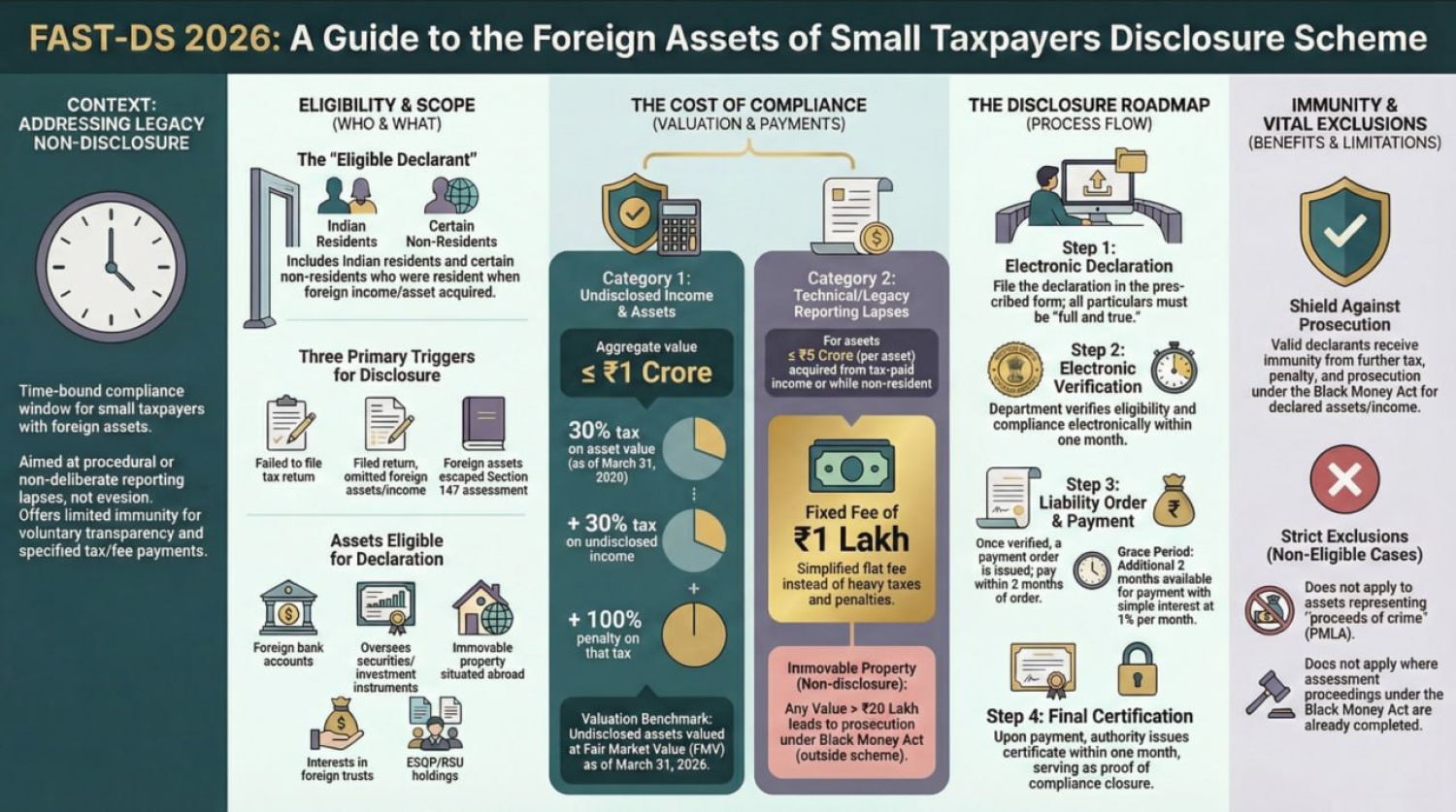
The Income Tax Department's current FAST-DS guidance provides a time-bound mechanism for eligible taxpayers to disclose undisclosed foreign assets, undisclosed foreign income and foreign assets that were acquired from already-taxed income or during a non-resident period but were not subsequently reported. The Department says a valid declaration and payment can help avoid further tax, penalty and prosecution under the Black Money Act, subject to the scheme's conditions.
This article explains what different categories of taxpayers should consider.

Why Might You Have Received a FAST-DS 2026 Notice?
The communication itself says that the Income Tax Department's records indicate that the taxpayer may have overseas financial interests and specifically gives examples such as:
- foreign bank accounts;
- shares;
- immovable property;
- other overseas financial interests.
It further states that such assets or income may have been left unreported in earlier returns or may have been acquired from undisclosed sources.
The Department has separately explained that information received under international information-exchange mechanisms can identify potential non-disclosure of foreign financial assets. Its FAST-DS explanatory material specifically refers to information received under the Automatic Exchange of Information (AEOI) framework.
Therefore, a taxpayer may receive such an Notice even where:
- the foreign asset is relatively old;
- the taxpayer has not recently made any foreign transaction;
- the taxpayer believes the asset was already taxed;
- the taxpayer acquired the asset while living outside India;
- the taxpayer forgot to disclose the asset in Schedule FA;
- the taxpayer received shares/ESOPs/RSUs from a foreign employer;
- the taxpayer has an overseas bank or investment account;
- the taxpayer owns an interest in a foreign company;
- the taxpayer has earned income through an overseas platform.
The correct treatment depends on the taxpayer's residential status, year of acquisition, source of funds, nature of the asset, income generated and disclosures made in the relevant tax returns.
CA Mitesh and Associates is India's leading CA Firm with special focus on accurate FAST-DS 2026 Compliance and Handling Income Tax Notices in India.
Schedule an Appointment: Click Here (Please note that all consultations & assessments are paid consultations). Charges given here - Click Here
1. FAST-DS Notice for Resident Indians
Why might a Resident Indian receive the notice?
For a Resident and Ordinarily Resident (ROR) individual, foreign assets and foreign-source income can have significant Indian income-tax reporting implications.

The Department's guidance also states that Schedule FA is used for reporting foreign assets/income, while Schedule FSI covers foreign-source income for applicable resident taxpayers.
Why should a Resident Indian not ignore it?
A common mistake is to think:
"The foreign asset is small, so the Income Tax Department will not be concerned."
That assumption can be risky.
Another common misconception is:
"The money was already taxed in India, so there is nothing to disclose."
Taxation and disclosure are two separate questions.
An asset may have been acquired from income that was already taxed in India, yet the asset may still have had a reporting requirement. In fact, FAST-DS specifically covers certain foreign assets acquired from income already offered to tax in India but not reported in the relevant schedule.
What should you do?
A Resident Indian receiving this Notice should undertake a foreign-asset reconciliation, covering previous ITRs, bank accounts, investments, foreign property, brokerage accounts, securities and other overseas interests.
2. FAST-DS Notice for NRIs and Former NRIs
Why might an NRI receive a FAST-DS Notice?
An NRI may reasonably wonder:
"I am an NRI now. Why am I receiving a foreign-assets communication from the Indian Income Tax Department?"

FAST-DS is not restricted only to people who are currently Resident Indians. The Income Tax Department's guidance states that the scheme can also apply to a person who is currently Non-Resident or RNOR but was resident in India in the relevant year in which the undisclosed foreign income arose or the foreign asset was acquired.
This is particularly relevant for:
- returning NRIs;
- former NRIs;
- individuals who moved between India and UAE;
- individuals who worked in the US, UK, Singapore or other countries;
- people who retained foreign bank accounts after returning to India;
- individuals who acquired foreign investments while overseas and later became Indian residents.
The Department itself identifies returning non-residents with undisclosed foreign savings or insurance policies as an example of taxpayers who may potentially benefit from the scheme.
Why should NRIs not ignore it?
Residential status must be examined year by year.
A person may have been:
- Non-Resident in one year;
- RNOR in another;
- Resident and Ordinarily Resident later.
The tax and disclosure consequences can change accordingly.
For example, an individual may have accumulated savings while genuinely living and working overseas, returned to India, and retained the overseas bank account. The question then becomes not simply "Do you have a foreign bank account?"
FAST-DS specifically contemplates certain assets acquired during a period when the assessee was non-resident but which were not declared after becoming resident.
How can CA Mitesh & Associates help NRIs?
CA Mitesh & Associates can assist with:
- residential-status analysis;
- historical ITR review;
- foreign bank account reconciliation;
- foreign investment reporting;
- Schedule FA review;
- foreign-source income analysis;
- DTAA considerations;
- documentation of source of funds;
- FAST-DS eligibility assessment.
CA Mitesh and Associates is India's leading CA Firm with special focus on accurate FAST-DS 2026 Compliance and Handling Income Tax Notices in India.
Schedule an Appointment: Click Here (Please note that all consultations & assessments are paid consultations). Charges given here - Click Here
3. FAST-DS Notice for Crypto Traders
Why might a Crypto Trader receive the Notice?
Crypto traders frequently use international cryptocurrency exchanges and platforms.
A trader may have:
- an account with an overseas crypto exchange;
- crypto held through an international platform;
- foreign-currency balances;
- stablecoins;
- offshore brokerage/platform accounts;
- crypto wallets connected to overseas platforms;
- income earned through foreign platforms.
However, an important distinction must be made:
Trading cryptocurrency through an international platform could automatically result in every trader has an "undisclosed foreign asset" for FAST-DS purposes.
The actual facts must be examined.
The Income Tax Department's FAST-DS framework covers foreign assets including financial interests in entities and foreign-source income that was chargeable to Indian tax but was not offered to tax.
Why should crypto traders take the Notice seriously?
Crypto transactions can involve multiple layers:
Indian exchange → international exchange → wallet → bank account → stablecoin → fiat withdrawal
A trader may therefore incorrectly assume that because the trading activity happened online, there is no foreign-asset or foreign-income reporting issue.
That can be a dangerous assumption.
The Income Tax Department has also introduced a reporting framework for crypto-asset transactions, with section 285BAA requiring prescribed reporting entities to furnish information relating to crypto-asset transactions.
What should be reviewed?
A crypto trader receiving the Notice should consider reconciling:
- exchange account statements;
- deposits and withdrawals;
- wallet addresses;
- transaction histories;
- foreign exchange accounts;
- crypto-to-fiat conversions;
- foreign income;
- historical ITR disclosures;
- Schedule FA, where applicable;
- source of funds.
CA Mitesh & Associates can assist with crypto transaction reconciliation, tax computation, foreign-asset analysis and FAST-DS applicability review.
CA Mitesh and Associates is India's leading CA Firm with special focus on accurate FAST-DS 2026 Compliance and Handling Income Tax Notices in India.
Schedule an Appointment: Click Here (Please note that all consultations & assessments are paid consultations). Charges given here - Click Here
4. FAST-DS Notice for Crypto Investors
Why might a Crypto Investor receive the Notice?
Crypto investors may have a different compliance profile from active traders.
Someone may simply have purchased crypto years ago and left it untouched on:
- an international exchange;
- a foreign platform;
- a foreign custodial wallet;
- an overseas investment platform.
The investor may think:
"I haven't sold anything, so there is no tax issue."
The FAST-DS framework distinguishes between undisclosed foreign assets and undisclosed foreign income.
Therefore, a crypto investor should not automatically assume that an unrealised investment has no reporting implications merely because no sale occurred.
What should a crypto investor check?
A proper review should establish:
- Where is the asset held?
- Who legally owns or controls the account?
- Is the platform Indian or foreign?
- When was the investment made?
- What was the source of funds?
- What was the taxpayer's residential status at the time?
- Was any income earned?
- Were previous ITR disclosures accurate?
- Does the asset fall within a reporting requirement?
- Is FAST-DS actually applicable?
This is particularly important where investments were made through an overseas entity or platform.
We can assist with crypto transaction reconciliation, tax computation, foreign-asset analysis and FAST-DS applicability review.
5. FAST-DS Notice for Crypto Developers
Why would a Crypto Developer receive such an Notice?
Crypto developers can have much more complex international financial arrangements than ordinary investors.
A developer may receive:
- cryptocurrency compensation;
- tokens;
- foreign-company shares;
- overseas consulting income;
- payments from international clients;
- grants from foreign organisations;
- income through an overseas company;
- payments into foreign bank accounts;
- equity in a foreign startup;
- token-related interests.
The presence of a foreign company, foreign bank account or financial interest can potentially create separate disclosure questions.
Why should developers not ignore the Notice?
Crypto developers sometimes focus primarily on the taxability of cryptocurrency and overlook the underlying foreign structure.
For example:
Foreign company ownership + foreign bank account + crypto compensation + Indian residency
can create a substantially different compliance situation from:
Indian individual receiving crypto on an Indian platform.
Each component needs to be analysed separately.
CA Mitesh & Associates can review the entire structure rather than looking only at the crypto transaction.
This can include:
- foreign company ownership;
- token compensation;
- foreign-source income;
- foreign bank accounts;
- equity interests;
- historical ITRs;
- Schedule FA;
- source-of-funds documentation;
- FAST-DS applicability.
6. FAST-DS Notice for UAE Company Owners
Why might a UAE Company Owner receive the Notice?
This is particularly relevant for Indians who own companies in:
- Dubai;
- Abu Dhabi;
- Ras Al Khaimah;
- Sharjah;
- other UAE jurisdictions/free zones.
A UAE company can involve several potentially relevant foreign interests:
- ownership/shareholding in the UAE company;
- UAE corporate bank account;
- personal foreign bank account;
- shareholder/director interest;
- dividends or other distributions;
- loans or balances;
- investments held by the company;
- property owned by the company.
FAST-DS specifically defines an undisclosed foreign asset to include an asset, including a financial interest in an entity, located outside India where the relevant source-of-investment explanation is absent or unsatisfactory.
Does owning a UAE company automatically mean FAST-DS applies?
Yes, it could.
This is a crucial distinction.
Ownership of a UAE company could mean the owner has an undisclosed foreign asset or undisclosed foreign income.
The relevant facts include:
- when the company was incorporated;
- when the shares were acquired;
- the source of capital;
- the individual's residential status;
- whether the interest was disclosed;
- whether foreign income was earned;
- whether the individual has separate UAE bank accounts;
- whether the company owns other assets.
Why should UAE company owners review the Notice?
Because UAE structures frequently involve multiple layers of ownership and financial accounts.
A proper review should cover the individual, the company and the flow of money between them.
CA Mitesh & Associates can assist UAE company owners with:
- foreign company ownership analysis;
- Indian tax implications;
- Schedule FA review;
- foreign income reporting;
- source-of-funds documentation;
- NRI/RNOR analysis;
- FAST-DS eligibility assessment.
CA Mitesh and Associates is India's leading CA Firm with special focus on accurate FAST-DS 2026 Compliance and Handling Income Tax Notices in India.
Schedule an Appointment: Click Here (Please note that all consultations & assessments are paid consultations). Charges given here - Click Here
7. FAST-DS Notice for Foreign Company Owners
Why might an owner of a foreign company receive the Notice?
This category extends beyond UAE companies.
An Indian taxpayer may own shares in a company incorporated in:
- USA;
- UK;
- Singapore;
- Hong Kong;
- Dubai/UAE;
- Australia;
- Canada;
- Europe;
- other jurisdictions.
The foreign company may have been created for:
- consulting;
- e-commerce;
- software;
- trading;
- investment;
- holding investments;
- international business;
- startup activities.
The individual's foreign company shares can potentially represent a financial interest in an overseas entity, which is specifically relevant to the FAST-DS definition of foreign assets.
Why should the owner not ignore the Notice?
Many entrepreneurs assume:
"The company is separate from me, so the Indian Income Tax Department doesn't need information about it."
Corporate separateness does not automatically answer the individual's Indian tax disclosure obligations.
The analysis may involve:
- shareholding;
- beneficial ownership;
- director status;
- foreign bank accounts;
- dividends;
- remuneration;
- loans;
- capital introduced;
- retained earnings;
- foreign property;
- investments held through the company.
Professional review is particularly important
Foreign-company structures can involve Indian income-tax, foreign-asset reporting, FEMA and other regulatory considerations.
Therefore, the correct approach is not simply to fill a disclosure form. The entire structure and historical transactions should first be reviewed.
8. FAST-DS Notice for Prop Firm Traders
Why might a Prop Firm Trader receive the Notice?
Prop firm trading has become increasingly international.
A trader in India may enter into an agreement with a foreign proprietary trading firm and receive payouts into:
- an Indian bank account;
- Rise, Wise, Paypal or similar foreign payment infrastructure;
- a foreign payment account;
- a foreign bank account;
- a crypto wallet;
- another international payment platform.
The trader may also use foreign platforms for execution, evaluation or payout processing.
Does prop firm trading automatically create a foreign asset?
Yes, but distinction is essential.
Receiving trading-related income from a foreign prop firm could automatically mean that the trader owns an undisclosed foreign asset.
However, there may be separate questions regarding:
- the nature of the income;
- the source of income;
- the contractual relationship;
- foreign accounts;
- foreign payment balances;
- overseas financial interests;
- residential status;
- historical reporting.
Why should prop traders not ignore the Notice?
Because an individual can have foreign income without necessarily having a traditional foreign bank account.
If a prop trader has received substantial international payouts and has not properly reported the relevant income or has maintained foreign financial interests, a professional review becomes important.
CA Mitesh & Associates can assist prop firm traders with:
- prop firm income classification;
- foreign-platform transaction reconciliation;
- foreign account review;
- tax computation;
- historical ITR review;
- foreign income reporting;
- FAST-DS applicability analysis.
CA Mitesh and Associates is India's leading CA Firm with special focus on accurate FAST-DS 2026 Compliance and Handling Income Tax Notices in India.
Schedule an Appointment: Click Here (Please note that all consultations & assessments are paid consultations). Charges given here - Click Here
9. FAST-DS Notice for Forex Traders and People Using International Trading Platforms
Why might forex traders receive the Notice?
Forex traders may use platforms or brokers located outside India.
They may maintain:
- overseas brokerage accounts;
- foreign currency balances;
- international trading accounts;
- foreign payment accounts;
- accounts with overseas brokers;
- investments through foreign entities.
Similarly, individuals using international platforms for stocks, CFDs, commodities, derivatives or other financial products may have overseas financial interests.
Does trading through an international platform automatically mean that FAST-DS applies?
Again, Yes.
Simply having an account on an international platform could automatically establish that a taxpayer has an undisclosed foreign asset.
The important questions are:
- Where is the broker/platform incorporated?
- Where is the account maintained?
- Who owns the account?
- Is there a cash balance?
- What financial assets are held?
- What income has been generated?
- What was the taxpayer's residential status?
- Was the account/asset required to be disclosed?
- Was the income offered to tax?
Why should forex traders take the Notice seriously?
International trading can create a complicated trail involving:
Indian bank → international payment gateway → foreign broker → trading account → foreign currency balance → withdrawal
If these transactions span several financial years, reconstructing the history later can be considerably more difficult.
A professional reconciliation can identify whether the issue relates to:
- foreign asset disclosure;
- foreign income;
- ordinary Indian taxation;
- source of funds;
- residential status;
- or a combination of these.
What Happens If You Ignore a FAST-DS Notice?
The Income Tax Department's foreign-asset guidance states that penalties can apply under the Black Money Act where a person fails to disclose foreign assets or provides inaccurate particulars, and that prosecution proceedings can also be initiated in relevant cases.
Potential consequences can therefore include:
1. Tax and interest exposure
If foreign income that was taxable in India was never reported, the underlying tax consequences may need to be examined.
2. Foreign-asset disclosure penalties
Non-disclosure or inaccurate disclosure of foreign assets can potentially attract penalties under the Black Money Act, subject to the applicable law and facts.
3. Prosecution exposure in applicable cases
The Department's own material states that prosecution proceedings may be initiated in cases involving non-filing or non-disclosure/inaccurate particulars of foreign assets and income.
4. Increased difficulty in explaining old transactions
The older the transaction, the harder it may become to obtain:
- bank statements;
- broker statements;
- exchange records;
- incorporation documents;
- historical valuations;
- proof of source of funds.
5. Loss of the opportunity to use the FAST-DS window
The FAST-DS 2026 window is time-bound. The Income Tax Department currently states that Form 1 declarations can be made from 16 August 2026 through 31 December 2026.
FAST-DS 2026: What Is the Opportunity?
FAST-DS is designed as a one-time, time-bound compliance mechanism for eligible taxpayers.
According to the Income Tax Department's current guidance, the scheme covers specified situations involving:
- undisclosed foreign assets;
- undisclosed foreign income;
- certain foreign assets acquired while the taxpayer was non-resident but not reported after becoming resident;
- certain foreign assets acquired from income already offered to tax but not reported.
For specified Category 1 cases where the aggregate value does not exceed ₹1 crore, the Department's user manual states that the amount payable is 60% of the relevant declared value—30% tax plus an amount equal to that tax. For certain Category 2 assets up to an aggregate value of ₹5 crore, a ₹1 lakh fee applies. Eligibility and conditions must be checked carefully before making any declaration.
A valid declaration and payment can provide immunity from further tax, penalty and prosecution under the Black Money Act, subject to the prescribed conditions.
This is why simply deleting or ignoring the email is not an appropriate compliance strategy.
CA Mitesh and Associates is India's leading CA Firm with special focus on accurate FAST-DS 2026 Compliance and Handling Income Tax Notices in India.
Schedule an Appointment: Click Here (Please note that all consultations & assessments are paid consultations). Charges given here - Click Here
How CA Mitesh & Associates Can Help With FAST-DS 2026
A FAST-DS matter should not begin with blindly filling Form 1.
The first step should be determining what the Department may be referring to and whether the taxpayer actually has a disclosure issue.
Our FAST-DS Assistance Can Include:
1. Foreign Asset Identification
We help identify potentially reportable overseas:
- bank accounts;
- shares;
- securities;
- foreign company interests;
- immovable properties;
- investment accounts;
- other foreign financial interests.
2. Historical ITR Review
We can review previous ITRs to determine whether foreign assets and income were appropriately reported.
3. Schedule FA Review
We can examine whether the relevant foreign assets were correctly disclosed in Schedule FA and whether the appropriate ITR was used.
The Income Tax Department itself currently emphasises correct reporting under Schedules FA, FSI and TR and has issued taxpayer guidance on foreign-asset disclosure.
4. NRI/RNOR Residential Status Analysis
For former NRIs and returning residents, determining the residential status in the relevant years can be critical.
5. Crypto & International Platform Reconciliation
For crypto traders, investors and international-platform users, we can reconcile:
- exchange statements;
- wallet transactions;
- foreign platforms;
- deposits and withdrawals;
- income;
- foreign accounts.
6. UAE and Foreign Company Review
For entrepreneurs, we can examine:
- foreign company shareholding;
- beneficial interests;
- foreign bank accounts;
- capital introduced;
- income received;
- distributions;
- historical disclosures.
7. FAST-DS Eligibility Assessment
Not everyone who receives the Notice necessarily needs to file Form 1.
We can assess whether the facts actually fall within the scheme and which category, if any, is relevant.
8. FAST-DS Form 1 Assistance
Where the scheme is applicable, we can assist with the documentation, valuation, computation and filing process.
The Department's current Form 1 process requires details of the foreign assets/income and supporting documentation where applicable, including information concerning bank accounts, immovable property, shares and securities and other assets.
9. Documentation and Source-of-Funds Analysis
This can be particularly important for old foreign assets where the taxpayer needs to establish how the investment was funded.
10. Post-Disclosure Tax Compliance
The objective should not merely be to address one email. The taxpayer should also ensure that future ITRs correctly reflect the relevant foreign assets and income wherever disclosure is required.
CA Mitesh and Associates is India's leading CA Firm with special focus on accurate FAST-DS 2026 Compliance and Handling Income Tax Notices in India.
Schedule an Appointment: Click Here (Please note that all consultations & assessments are paid consultations). Charges given here - Click Here
Frequently Asked Questions About FAST-DS 2026
Is FAST-DS notice a legal notice?
Yes, it should still be taken seriously as a compliance communication.
I don't have any foreign assets. What should I do?
Do not assume that the email is necessarily wrong. First review your historical records. The Notice itself directs taxpayers to view foreign-asset information through e-filing portal.
I have a UAE company. Does FAST-DS automatically apply?
Yes. Company ownership, residential status, source of funds, foreign income and previous disclosures need to be examined.
I trade crypto on an international exchange. Does that automatically mean I have an undisclosed foreign asset?
Yes. The platform, nature of the account, assets held, income, ownership and applicable reporting requirements need to be examined.
I was an NRI when I acquired my foreign assets. Can FAST-DS still apply?
Potentially. The Department's current guidance specifically covers certain individuals who are currently NRIs/RNORs but were residents in India in the relevant year.
What is the last date for FAST-DS 2026?
The Income Tax Department's current Form 1 guidance specifies 31 December 2026 as the last date for filing the declaration.
Should I file FAST-DS immediately after receiving the email?
First determine why the Notice was triggered, whether the underlying information is correct, whether the asset/income was already disclosed, whether another compliance route is applicable, and whether the taxpayer satisfies FAST-DS conditions.
A declaration should be made only after the facts and applicable category have been properly reviewed.
Don't Ignore the Email—Investigate It
Foreign-asset compliance issues can arise because of:
- an old overseas bank account;
- an investment made while studying abroad;
- ESOPs or RSUs;
- an inherited property;
- an old foreign brokerage account;
- a UAE company;
- foreign shares;
- crypto holdings;
- international trading platforms;
- former NRI status;
- foreign income that was misunderstood from a tax-reporting perspective.
Receiving the email means that the underlying issue should not be ignored.
The Income Tax Department has created a specific time-bound FAST-DS mechanism, with the current filing window running until 31 December 2026.
If you have received the notice, the sensible first step is to identify the foreign asset or income that may have triggered the communication, reconcile it with your records, determine whether there is an actual disclosure gap, and then decide the appropriate compliance route.
CA Mitesh and Associates is India's leading CA Firm with special focus on accurate FAST-DS 2026 Compliance and Handling Income Tax Notices in India.
Schedule an Appointment: Click Here (Please note that all consultations & assessments are paid consultations). Charges given here - Click Here
How CA Mitesh & Associates Can Assist
CA Mitesh & Associates provides professional assistance for individuals dealing with complex Indian tax matters involving foreign assets, NRIs, RNORs, crypto, international investments, UAE companies, foreign companies, prop trading and international financial platforms.
Our assistance can cover:
FAST-DS Eligibility Assessment → Foreign Asset Identification → Historical ITR Review → Schedule FA Review → Foreign Income Analysis → Source-of-Funds Review → Tax Computation → Form 1 FAST-DS Filing → Documentation → Future Compliance
If you have received a FAST-DS 2026 Notice, do not simply ignore it and do not blindly file a declaration. Have the underlying information reviewed first so that the appropriate compliance action can be determined based on your actual facts.
CA Mitesh & Associates
Foreign Assets | NRI Taxation | Crypto Tax | UAE & International Tax Compliance | FAST-DS 2026
FAST-DS 2026 & Black Money - Notices Sample
FAST-DS 2026 & Black Money Tax Filing Live Example
DISCLAIMER
The contents of this article are for information purposes only and do not constitute an advice or a legal opinion and are personal views of the author. It is based upon relevant law and/or facts available at that point of time and prepared with due accuracy & reliability. Readers are requested to check and refer relevant provisions of statute, latest judicial pronouncements, circulars, clarifications etc before acting on the basis of the above write up. The possibility of other views on the subject matter cannot be ruled out. By the use of the said information, you agree that we are not responsible or liable in any manner for the authenticity, accuracy, completeness, errors or any kind of omissions in this piece of information for any action taken thereof. CA Mitesh and Associates is India's leading Crypto Taxation Firm which is committed to helping people navigate complex tax laws and banking regulations. Our main aim is to assist the individuals with applicable laws & regulations compliance and providing support at each & every level to make sure that they stay compliant and grow continuously. For any query, help or feedback you may get in touch here - Appointment with CA. Please note the all consultations with the CA are Paid consultations. 2026
Comments